3 December 2006

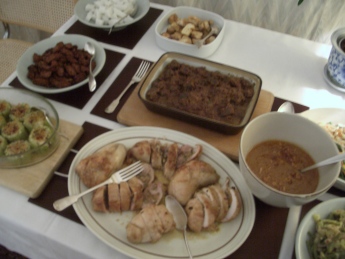
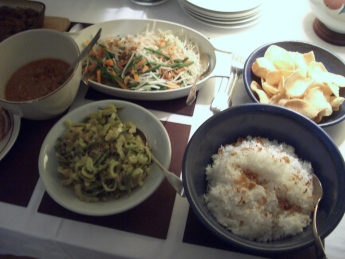
Two days ago, I cooked dinner for four new friends who I met recently at Asia House in London. Three of them were Indonesians, like myself, and the fourth was an Englishman - they were two married couples, in fact. It was a very enjoyable and very busy evening, and we went on eating and talking until quite late. I took a couple of pictures of the dishes when all the food was laid out on the table, ready for everyone to help themselves. (This is how we always do dinner parties and feasts: there are no courses, the guests just keep coming back for more.)

CIMG1821.JPG Now, this is not the best way to do food photography, but I can name the dishes and quickly describe each so you can get an idea of what an Indonesian meal for guests looks like. Starting at the top: the white chunks are lontong, rice which has been boiled for 75 minutes or so in a bag so that the grains are pressed into a solid mass which is left to cool, then cut into cubes. Next, in the square white dish, there are cubes of cooked beancurd or tofu (tahu in Indonesian). Middle row: on the left, tempe goreng - a 'cake' of fermented soy beans, cut up, marinaded in tamarind water with garlic and shallots, and fried. In the large square dish: beef rendang, one of the Indonesian and Malaysian classics. The big round bowl near it contains peanut sauce, which we call sambal kacang or bumbu sate - in this case, intended to go with the slices of stuffed chicken on the large oval platter. On the left of the chicken, a glass dish of bitter melons, cut into thick slices and stuffed. Bitter melons (paria) are expensive in London because they have to be flown from Thailand, but bitter tastes are essential for any Southeast Asian meal, to balance the hot, salty, and sweet tastes of other dishes - I'll say more about this balance of tastes on my Recipe page soon.

CIMG1822.JPG Here, you can see the satay sauce on the left. To the right of it,  top, is an oval plate of a cooked salad of bean sprouts, with a few lightly-boiled green beans and julienned carrot to give it some colour. Right of that, a blue bowl with fried krupuk or prawn crackers, which are like the 'shrimp slices' you get in Chinese restaurants, but larger, pinker, and more tasty. Bottom row: another cooked salad of sliced green sweet peppers, more bitter melon, and green beans. Nearest the camera, a big bowl of plain boiled rice (Thai jasmine: this is the nearest I can find in England to the Sumatran and Javanese rices that I was brought up on).

You can see now that it might take six hungry people quite a while to get through that lot, especially as we were all talking the whole time! And what about dessert? you ask. Well, one of my Indonesian guests brought with her a huge dish of tiramisu, and that made us very happy. Tiramisu is popular, I think, all over Asia, and especially in Japan - indeed, some (non-Japanese) people think 'tiramisu' is a Japanese word. In fact, of course, it's Italian - for me, further proof that Italy and Indonesia have much in common, foodwise anyway - and it goes beyond pasta and noodles.

I remind you that you can find the peanut sauce recipe in my Recipes section. I'll be adding recipes for more of these dishes quite soon.

Posted on Sunday, December 3, 2006 at 03:51PM by Registered CommenterSRI OWEN | CommentsPost a Comment

30 November 2006

Somebody has reminded me that this website or blog is supposed to be about Southeast Asian food, and don't worry, I'm coming to that. I just want to say a few things more about our recent Italian trip and the places we stayed at and the food we ate - if I run out of restaurants to talk about, I might give you the recipes for some of the good things I cooked in our foresteria (see 27 November).

One restaurant I have to mention is Gigetto. It's in a small town called Miane, on the road from Vittorio Veneto to Valdobbiadene. (Even if you don't speak Italian, you score points with friends there if you pronounce that name with the stress in the right place - it's val-do-BYA-de-ne.) This road is so fascinating that it deserves a page to itself: it winds between, around, occasionally up onto, the steep foothills of the Dolomites, often with sweeping views towards the plain and the sea - from one or two high spots, on a clear day, you should be able to see the towers of Venice. These hills are almost completely given over to the cultivation of the prosecco grape, and most of their inhabitants seem to make a good living from it, as growers or winemakers.

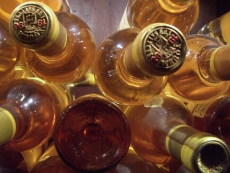
CIMG1703.JPG Fittingly, Gigetto offers not only excellent food but a magnificent cellar, a catacomb of wine that wriggles away under the various small and large dining-rooms of the restaurant and out, by my reckoning, beneath the roots of the vines and deep into the hillside. On the website that I linked to above, you can see a picture of just one little corner, twist, or possibly dead-end, in this labyrinth of a cellar, its walls lined and its floor stacked high with fine vintages, wines from all over the world, brandies, grappa, single-malt Scotch from every distillery, it seems to go on and on...

Posted on Thursday, November 30, 2006 at 12:29PM by Registered CommenterSRI OWEN | CommentsPost a Comment

28 November 2006

There is so much to be said about Venice, and would-be writers keep on saying it over and over, so I think I'll stick to the food. First, of course, the market - the amazing Rialto - street theatre newly invented every weekday morning, thronged with people, as filled with action as it must have been when Shakespeare imagined that dodgy loan negotiated between Antonio and Shylock. But nowadays they don't fix business deals on the Rialto, and the tourists and the locals mingle happily as they buy fresh fruit and vegetables, fish and seafood, all brought in (one supposes) from the lagoon and the Adriatic Sea and the great Venetian plain that spreads from here to the foot of the Dolomites. In fact, the lagoon is probably too polluted to give much of a living to any fish, and the plain is heavily urbanised, much of it under concrete. Still, there's quality here, some of it brought from a long way away: fish from the Indian Ocean, tropical fruits, vegetables flown in from Africa. Never mind - the quality is high, the choosing and buying theatrically noisy.

CIMG0997.JPG

Here I am, choosing fish (with some help from a Venetian friend who is also a cookery teacher) among the stone columns of the fish market. And look at these chillies and artichokes - I don't think I've ever seen stuff as good as this in England.

CIMG1362.JPGCIMG1365.JPG


But soon it was lunch time ... A friend had given me the name of a small restaurant called Vecio Fritolin, and the street address. Except that there aren't any street addresses in Venice; the city is divided into six segments, called sestriere, and in  each sestier the buildings are simply numbered 1,2,3 .. up to however many there are - usually over 2000. After asking various shopkeepers, and their assistants and customers and passers-by (in Venice, everyone joins in), and after an outburst of mild panic in case we missed lunch altogether, we found it ... but don't ask me to find my way there again. I can only assure you it is well worth the effort, and the fun, of re-discovery (in the Calle della Regina). It's in a long tradition of Venetian fried fish restaurants, and both the setting and the cooking are quietly perfect.

CIMG1413.JPG These soft-shell crabs might perhaps have been the same ones that I'd watched, an hour or two earlier, scrambling hopefully around on a market stall while they waited for someone to buy them. The man who was selling them just picked them up in handfuls, like wriggling chestnuts, and popped them into a bag. Roger went for the mixed fried fish, which actually arrived on a sheet of paper, just as they were served in the old days for people to take away and eat in the street.
CIMG1721.JPG 


Posted on Tuesday, November 28, 2006 at 08:10PM by Registered CommenterSRI OWEN | CommentsPost a Comment

27 November  2006

I'm going to start off this blog with some words about our recent trip to the Veneto - the bit of north-east Italy between the coast and the mountains. Of course, the jewel of this is Venice, a city we've been to many times, starting in the days when we spent summer holidays travelling round Europe in an old car, with a tent, a Camping-Gaz stove, and one small son, then two ... I still remember buying fresh fish in the Rialto and cooking wonderful al fresco suppers ... but that's all far in the past. I admit that nowadays I like to sleep in a comfortable bed and eat at least some of my meals in the best restaurants I can find (and afford). But I still love to shop in real Italian food shops and markets (including the Rialto), and cook dishes which are part Italian, part Indonesian - food-wise, the two countries, though so different, seem to understand each other rather well.

 Of course, this means I need self-catering accommodation with a good kitchen. My husband Roger and I are lucky enough to know the family of wine producers who, two or three years ago, opened a foresteria - literally, 'a house in the woods', though really it's set among rolling hills that are covered in vineyards. This is the region of prosecco grapes and the light, sparkling wines that are made from them. The foresteria is an old stone building that once belonged to the Cistercians of an abbey somewhere in the district; its new owners have made it into a welcoming place, with spacious rooms, well-equipped kitchens, all mod. con., swimming pool etc. - and wonderful views. It's on a hillside above a tiny village called Rolle, where the  church clock always strikes the hour twice, in case you forgot to count the first time.

CIMG1651.JPG cloud on hill.JPG 


Just a little to the right  of the church in the picture is a restaurant I particularly like, even though it's unassumning, modestly priced, and usually crowded. In fact, it's usually full of friendly people thoroughly enjoying themselves, so what higher recommendation could you have? It's called Al Monastero di Rolle - just Monastero for short - perhaps for the Cistercians, though the atmosphere is totally unlike any monastery I have ever imagined. It operates on two floors; downstairs, one corner of the room is taken up by a great open range, in which the fire is always blazing while the spit turns before it. Upstairs, the same cheerful atmosphere but without the fire. The menu is fixed, so you have no problems choosing; the only problem is to eat all the food that is put before you. There are always two or three antipasti, then of course the primi, the pasta dishes, then the secondo, the main course, and finally the dolce, if you think you can face  another mouthful. The house wine is good local stuff, and at the end you will be offered a generous mouthful of grappa at no charge. Four of us ended up paying 30 euros / £21 / US$40 each for what was, in effect, a real old-fashioned Italian nobleman's feast, after which we retired to bed and slept soundly for eight hours. Be warned: Chef gets quite worried if anyone refuses a course merely because they 'aren't hungry'. The main course changes each night: Wednesday it's a grill, Thursday fish from the Adriatic, Friday a whole roast pig, and so on. Monday they're closed, and Tuesday they open only for a pre-booked party of at least 20. To arrive at Rolle after driving all day along the crowded autostrada, say hello to the staff at the foresteria and settle in, then trundle down to the Monastero for supper, is better than coming home - all the good feeling, and you don't even have to cook.

The other restaurant in Rolle, to the left of the church, is more conventional and more expensive, but also very good, well worth visiting at least once while you're in that rather remote, unspoiled corner of Italy - unspoiled (so far) because it's a protected area, where permission to develop property is hard to get.

 Well, that's enough for today - tomorrow, a few memories of Venice herself....

Posted on Monday, November 27, 2006 at 11:53AM by Registered CommenterSRI OWEN | Comments2 Comments